
Commercial Solar PV: The 2026 Strategic Guide for UK Businesses
- James

- May 11
- 12 min read
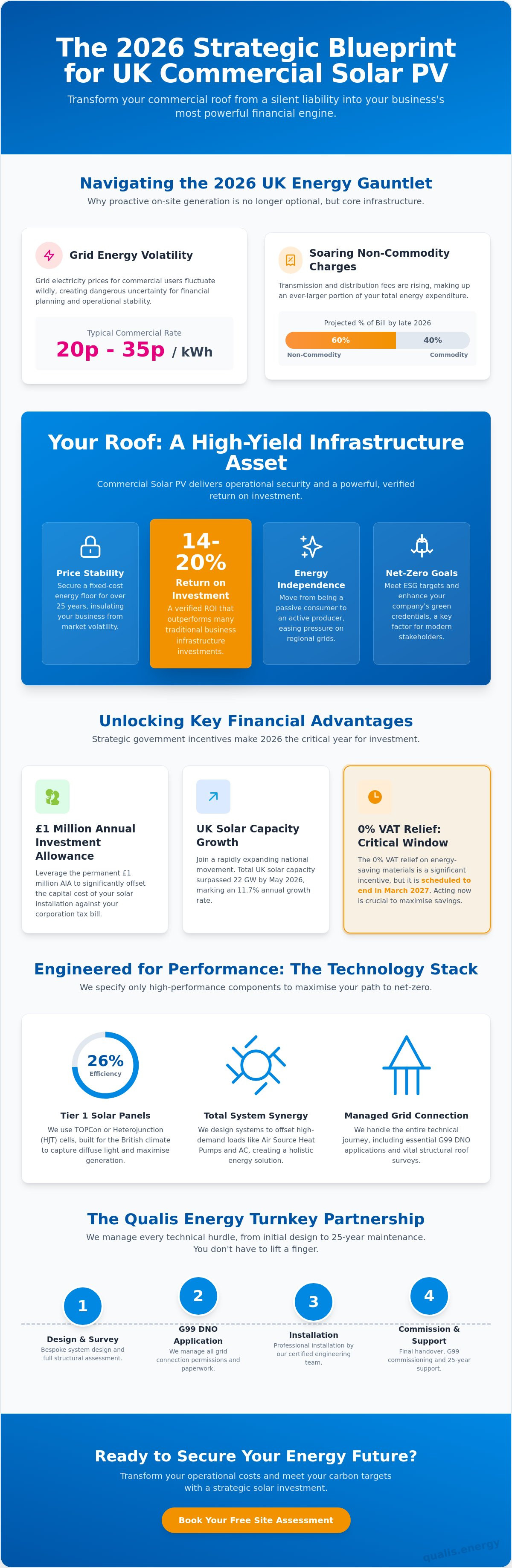
Your commercial roof is either a silent liability or your business's most powerful financial engine. By May 2026, the UK has surpassed 22 GW of total solar capacity, yet many firms still allow volatile energy tariffs to dictate their quarterly margins. Investing in commercial solar pv is no longer a peripheral environmental choice; it's the installation of core mechanical infrastructure that delivers a verified return on investment of up to 20%. We know you're facing the triple pressure of rising non-commodity charges, carbon reporting, and frustrating grid capacity limitations. You deserve a partner who holds the renewable energy flag high while managing every technical hurdle so you don't have to lift a finger. This guide provides the 2026 strategic blueprint to move your business from energy dependence to total operational security. We'll break down the £1 million Annual Investment Allowance, explain how to navigate G99 applications, and show you why the 0% VAT relief ending in March 2027 makes this the critical year for your investment.
Key Takeaways
Reframe your commercial roof as a high-yield infrastructure asset that secures long-term price stability against volatile energy markets.
Explore how commercial solar pv currently offers an ROI of 14-20% whilst leveraging the permanent £1 million Annual Investment Allowance.
Identify the technical requirements for grid connection, including the essential G99 DNO application process and vital structural roof surveys.
Understand why integrating high-efficiency Tier 1 panels with your specific internal loads is the only way to maximise your path to net-zero.
Discover the benefits of a turnkey partnership that manages everything from initial design to 25-year maintenance, ensuring you never have to lift a finger.
Table of Contents
The Strategic Role of Commercial Solar PV in 2026 UK Business Operations
The future of energy has arrived. For UK businesses in 2026, energy is no longer a variable utility cost to be managed; it's a strategic asset to be owned. We see commercial solar pv as the cornerstone of a critical national transition, moving firms from centralised, vulnerable dependencies to resilient, on-site generation. By March 2026, Solar power in the United Kingdom reached a total capacity of 22.1 GW, representing an 11.7% growth rate over the previous year. This isn't just about 'going green'. It's about installing high-yield infrastructure that delivers a fixed-cost energy floor for 25 years. We help you move from being a consumer to being a producer, turning your roof into a revenue-generating asset that secures your operational future.
Combating Energy Volatility and Price Hikes
Grid electricity for commercial users currently fluctuates between 20p and 35p per kWh. Non-commodity charges, such as transmission and distribution fees, are projected to account for nearly 60% of total business energy bills by the end of 2026. This volatility creates a dangerous environment for manufacturing and warehousing sites that require high power consistency. On-site generation provides a predictable financial anchor. By generating your own power, you shield your business from the aggressive peak-time tariff hikes common in industrial hubs like Nottingham and Sheffield. You become a local hero, easing the pressure on regional infrastructure whilst protecting your own margins. It's a pragmatic step toward energy independence that ensures your business remains competitive, regardless of global market shifts.
Meeting ESG and Carbon Reduction Targets
Your stakeholders and clients now demand transparent renewable energy credentials before they sign a contract. A high-performance solar array serves as the visible flag of your company’s commitment to net-zero. It signals that your business is proactive, socially responsible, and prepared for the long term. Beyond reputation, commercial solar pv is a practical tool for improving EPC ratings, which is a growing necessity for commercial property owners. We manage the entire journey, from the first structural assessment to the final handover. You will not need to lift a finger to achieve the carbon reductions that the modern market requires. By securing your energy future today, you're not just saving money; you're educating the next generation and proving that British industry can lead the way in the global energy transition.
Designing a High-Performance Commercial Solar PV System
Excellence in commercial solar pv design starts with a fundamental shift in perspective. It's not just about covering a roof; it's about synchronising your generation with your specific operational heartbeat. We don't just bolt panels to a warehouse. We engineer a bespoke energy plant that moves your business from passive consumption to active energy management. A system is only as effective as its integration with your internal loads, and our role as a visionary facilitator is to ensure those two worlds meet seamlessly. We specify Tier 1 monocrystalline technology, particularly TOPCon or Heterojunction (HJT) cells which reach efficiencies of up to 26% in 2026. These panels are built for the British climate, capturing diffuse light even on those grey East Midlands afternoons.
Smart inverters act as the brain of your installation. They provide real-time performance monitoring, ensuring every string of panels performs at its peak. This level of oversight means we can identify and rectify issues before they impact your ROI. We manage the entire technical journey, moving the project from initial string mapping to final G99 commissioning. You won't need to lift a finger during the process, as our team handles the complex electrical engineering required to keep your site powered and protected.
Integrating Solar with Air Source Heat Pumps and AC
We bridge the gap between your roof and your plant room. A well-designed system can directly offset the electrical load of an air source heat pump installation, essentially providing carbon-free heating for your facility. There's a perfect synergy during the summer months; as the sun peaks, your air conditioning demand rises, allowing your solar array to shoulder the cooling load without touching the grid. System synergy is the ultimate goal of commercial energy design.
Battery Storage: Maximising Self-Consumption
For businesses with 24/7 operations, cold storage, or agricultural barns, battery storage is now a necessity. In 2026, we've seen a massive shift toward high-capacity lithium-ion and flow batteries for industrial use. This allows you to "arbitrage" the grid. You charge your cells when rates are low or generation is high, then discharge when peak tariffs hit 35p per kWh. According to Solar Energy UK, integrated storage is now a standard feature in over 50% of new commercial projects because it secures your energy floor. We manage the entire integration process from survey to commissioning, ensuring your storage works in perfect harmony with your generation. If you're ready to see how these technologies fit your site, our team can design a bespoke energy roadmap for your facility.
Calculating ROI: Payback Periods and Financial Incentives
Financial clarity is the bedrock of any industrial investment. In 2026, the business case for commercial solar pv has never been more compelling, moving from a speculative "green" cost to a high-yield infrastructure asset. While grid electricity prices remain high, between 20p and 35p per kWh, the cost of generating your own power on-site is significantly lower. Most UK businesses now see a full return on investment (ROI) within 4 to 8 years. Given that these systems are designed to operate for 25 to 30 years, you're effectively securing nearly two decades of energy at a near-zero marginal cost. We guide you through this financial transition, ensuring your project moves from a capital outlay to a profit-generating powerhouse.
The UK government provides several powerful levers to accelerate this payback. The Annual Investment Allowance (AIA) now has a permanent limit of £1 million, allowing you to deduct 100% of the installation cost from your pre-tax profits in the very first year. For VAT-registered businesses, the reclaim process is straightforward, and the current 0% VAT rate on solar installations has been extended until March 31, 2027. This window of opportunity is narrow. After this date, the rate is scheduled to revert to 5%, making 2026 the strategic year for implementation. Understanding the UK planning policy for solar farms and rooftop installations is vital for navigating these incentives, as compliance ensures your eligibility for long-term benefits like the 10-year business rates exemption.
Capital Expenditure (CapEx) vs. Operational Expenditure (OpEx)
Choosing how to fund your transition is as important as the technology itself. Self-funding via CapEx offers the highest long-term ROI, as you own the asset and all the energy it produces from day one. However, Power Purchase Agreements (PPAs) have become a popular OpEx alternative in 2026. These models allow for zero-upfront costs, where a provider installs the system and you simply buy the generated electricity at a lower rate than the grid. We help you navigate these "from-to" journeys, moving your property from a standard commercial unit to a high-value, energy-independent asset where you won't need to lift a finger to manage the financial structuring.
Revenue Generation from Surplus Energy
Surplus energy is no longer wasted. Through the Smart Export Guarantee (SEG), businesses can sell excess electricity back to the grid at rates typically ranging from 3p to 15p per kWh. If your site includes battery storage, you can access lucrative, dynamic time-of-use tariffs that pay up to 24p per kWh during peak export windows. We're also seeing the rise of "peer-to-peer" energy trading within local business parks in the East Midlands. This allows you to sell surplus power directly to your neighbours, keeping energy wealth within the local community and further shortening your payback period. By holding high the renewable energy flag, you're not just saving on bills; you're creating a secondary income stream that strengthens your balance sheet.
The Road to Installation: Planning, DNO, and Structural Surveys
Turning a strategic vision into a physical asset requires navigating a complex landscape of technical and regulatory hurdles. We understand that the bureaucracy of a large-scale commercial solar pv installation can feel daunting. Our role as a visionary facilitator is to bridge this gap, moving your project from a theoretical design to a commissioned, grid-connected reality. We manage every detail, ensuring your business remains focused on its core operations whilst we handle the heavy lifting of compliance and engineering. The future of your energy shouldn't be stalled by paperwork.
The most common hurdle we encounter is the question of structural integrity. "Is my roof strong enough?" is the first objection we answer with data. Every project requires a professional structural survey to calculate the load-bearing capacity of your purlins or roof slabs. We determine whether your building requires a ballasted system for flat roofs or rafter-mounted fixings for pitched surfaces, ensuring your investment is secure for its 25-year lifespan. Most rooftop projects fall under Permitted Development Rights, which simplifies the planning process, though we always verify this with local authorities. We also maintain strict MCS accreditation, which is a mandatory requirement for your business to access Smart Export Guarantee (SEG) payments and ensure long-term reliability.
Distribution Network Operator (DNO) Applications
Grid connection is the most time-sensitive phase of your journey. For systems with an inverter capacity over 3.68kW per phase, a G99 application must be submitted to the DNO before any work begins. This process typically takes 8 to 12 weeks. In industrial hubs like Nottingham and Sheffield, grid constraints are a reality that requires expert negotiation with Northern Powergrid or National Grid. We manage this entire bureaucratic cycle so you don't lift a finger. We secure your connection rights and ensure your system is ready to export surplus energy the moment it's commissioned, preventing any delays in your ROI timeline.
Roof Suitability and CDM Compliance
Health and safety on a commercial site is non-negotiable. Large-scale installations must adhere to the Construction (Design and Management) Regulations 2015 (CDM 2015). We act as your principal contractor, managing the site's safety from the first scaffold pole to the final inverter check. Whether we're installing on agricultural barns or modern distribution centres, our team ensures a seamless delivery. You can see these principles in action in our solar panels for commercial buildings case study, which details the journey from survey to energy independence. If you're ready to assess your building’s potential, book your professional site survey today to begin your transition.
Partnering for Longevity: The Qualis Energy Turnkey Approach
The journey doesn't end when the last panel is secured. We believe that commercial solar pv is a multi-decade commitment to your site's operational efficiency. As a visionary facilitator, our role moves you from the initial complexity of design and G99 applications to the peace of mind that comes with a fully managed energy asset. We hold the renewable energy flag high so you can focus on your business, secure in the knowledge that your energy floor is protected. Our turnkey EPC service ensures you won't need to lift a finger, as we manage every stage of the project lifecycle from the first structural survey to the final commissioning.
We see each installation as a partnership rather than a transaction. It's about building a narrative of completeness and reliability that lasts for the 25-year lifespan of the technology. By integrating your generation with your specific load profiles, we ensure you aren't just saving money but actively participating in a national transition. We're here to help you show off those green credentials to your stakeholders, proving that British industry can be both profitable and socially responsible. We manage the technical expert side so you can enjoy the domestic comfort of a secure, low-cost energy supply.
Local Expertise and Rapid Response
Choosing a local commercial solar installer in the East Midlands provides a level of security that national contractors simply can't match. Whether you're managing agricultural barns in Newark or high-bay warehouses in Sheffield, we understand the specific industrial landscape of our region. This proximity allows for a rapid response that's vital for maintaining peak generation. We aren't just contractors; we're your neighbours. We're committed to social engagement and the education of the next generation, creating local employment and ensuring that the benefits of the solar transition stay within our community.
Your 25-Year Energy Partnership
Our relationship is built for the long term. Once the installation is complete, we move into the handover and training phase, where we show your team how to utilise real-time monitoring software. Peak system performance requires proactive care. Our maintenance packages cover everything from routine inverter health checks to structural inspections of the mounting systems. We ensure your system remains a high-yield asset for its entire 25-year lifespan, providing a fixed-cost energy floor that protects your margins. If you're ready to secure your energy independence and transform your roof into a revenue stream, contact Qualis Energy today to organise your commercial site survey.
Securing Your Business Energy Future in 2026
The future of energy has arrived. Transitioning your facility from a grid-dependent consumer to a self-sufficient producer is the most significant strategic move you can make in 2026. By leveraging the permanent £1 million Annual Investment Allowance and securing a verified ROI of up to 20%, you're installing more than just panels; you're installing financial certainty. We've detailed how commercial solar pv functions as a critical mechanical asset, shielding your operational margins from the projected 60% non-commodity charge burden on business bills. As G99 DNO application specialists and MCS accredited installers, our team provides the grounded, professional expertise needed to navigate complex grid constraints. Our local Nottingham and Sheffield support teams handle every detail from survey to maintenance so you don't need to lift a finger. The journey toward energy independence is a partnership, and we're ready to hold the renewable energy flag high for your site. Book your 2026 Commercial Solar Audit with Qualis Energy to define your roadmap to net-zero. Your roof is waiting to become your business's most valuable asset.
Frequently Asked Questions
Do I need planning permission for commercial solar PV in the UK?
Most commercial solar pv installations fall under Permitted Development Rights, meaning you don't usually need full planning permission. Exceptions apply if your building is listed, located in a conservation area, or if the installation exceeds specific size thresholds near a highway. We manage the entire verification process with your local planning authority to ensure your project is fully compliant before any work begins.
How long does a commercial solar PV installation typically take?
The physical installation on site usually takes between 1 and 3 weeks for most mid-sized industrial systems. However, the total project timeline from initial survey to commissioning is typically 12 to 16 weeks. This duration accounts for the mandatory G99 grid connection application and structural engineering reports required to ensure your roof is safe and ready for generation.
Can I install solar panels on a flat commercial roof?
You can definitely install solar on a flat roof using ballasted mounting systems that don't penetrate the roof membrane. These systems use weighted blocks to secure the array, preserving your building's watertight warranty whilst angling the panels at 10 to 15 degrees for optimal generation. Our engineers calculate the specific wind loading for your site to ensure the system remains secure for its 25-year lifespan.
What is a G99 application and why does my business need one?
A G99 application is a formal technical request to your Distribution Network Operator (DNO) to connect a generation system over 3.68kW per phase to the grid. It's a legal requirement for commercial solar pv projects to ensure that your local energy infrastructure can handle the extra power. We act as your technical facilitator, managing the complex engineering data submissions so you don't have to lift a finger.
How much can my business save on electricity bills with solar PV?
Businesses typically reduce their grid electricity reliance by 30% to 70% depending on their operational hours and the size of the array. By generating power on-site, you avoid non-commodity charges which can account for 60% of a standard commercial bill. If you operate refrigeration or heavy machinery during daylight hours, your savings are maximised as you're using "free" energy at the point of generation.
What maintenance is required for a commercial solar system?
Commercial systems are robust but require an annual electrical health check and periodic panel cleaning to maintain peak efficiency. We provide real-time monitoring software that alerts us to any performance drops immediately. Our proactive maintenance packages include inverter inspections and mounting structure checks, ensuring your energy floor remains stable and your investment is protected for decades to come.
Is my building suitable for solar if it was built before 1990?
Buildings constructed before 1990 are often suitable for solar, but they require a rigorous structural survey to assess the load-bearing capacity of the roof. Older steel or timber purlins must be checked against the added weight of the panels and potential wind uplift. If our survey identifies a need for reinforcement, we'll include this in the design phase to ensure the installation is safe and reliable.
Can I use solar panels to power my industrial air conditioning?
Solar energy is the perfect partner for industrial air conditioning because cooling demand peaks exactly when solar generation is at its highest. On hot summer afternoons, your AC units can run almost entirely on on-site generation, shielding you from expensive peak-time tariffs. This synergy significantly improves your ROI and ensures your facility remains comfortable without a corresponding spike in your energy expenditure.


Comments