
.png)
Solar Panels for Commercial Buildings: A Case Study in Energy Independence for Nottingham & Sheffield Businesses
- James

- 5 days ago
- 12 min read
Updated: 3 days ago
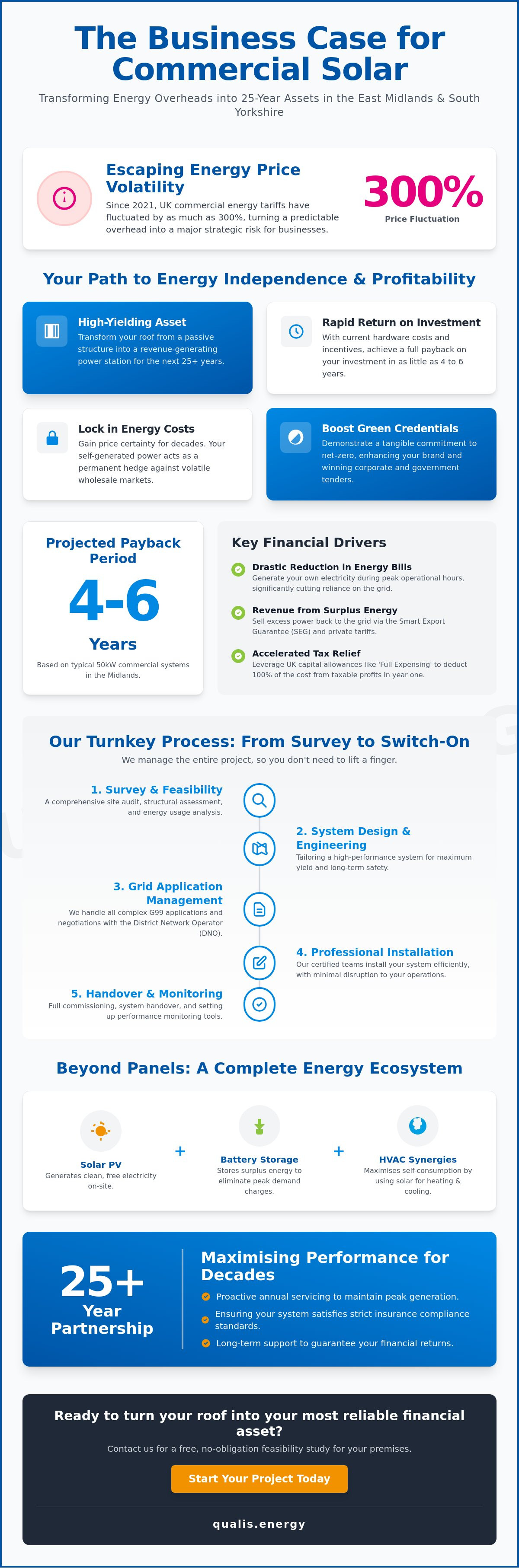
What if your business premises in Nottingham or Sheffield could function as its own power station, turning an unpredictable overhead into a guaranteed 25-year revenue stream? Since 2021, UK commercial energy tariffs have fluctuated by as much as 300%, leaving local directors searching for a way to install solar panels for commercial buildings without the headache of complex G99 applications. You likely recognise that grid dependency is now a strategic risk, especially when corporate tenders increasingly demand a transparent commitment to net-zero targets. We agree that managing the shift to renewables should feel like a professional partnership, not a burden on your internal resources.
This case study reveals how East Midlands and South Yorkshire businesses are eliminating price volatility and securing impressive returns through strategic PV investment. We'll guide you through our comprehensive project management process, from the first site survey to the final handover, ensuring you won't need to lift a finger during the installation. By the end of this piece, you'll understand how your firm can hold high the renewable energy flag while turning a passive roof into your most reliable financial asset.
Key Takeaways
Transform energy from a volatile overhead into a high-yielding asset, with projected break-even points for regional firms reaching as low as four to six years in 2026.
Navigate the technical complexities of G99 DNO applications and structural integrity to ensure your solar panels for commercial buildings are engineered for long-term safety.
Follow a step-by-step walkthrough of the installation journey, demonstrating how we manage the process from survey to handover so you do not need to lift a finger.
Discover how to achieve true energy independence by integrating solar PV with commercial battery storage and HVAC synergies to eliminate peak demand charges.
Understand why commercial solar is a 25-year partnership, requiring proactive annual servicing to maintain peak generation and satisfy strict insurance compliance standards.
The Financial Case: ROI for Solar Panels on Commercial Buildings in 2026
The energy paradigm has fundamentally shifted. For directors across Nottingham and Sheffield, electricity is no longer a passive monthly drain on the balance sheet; it is a self-generated asset. By 2026, the deployment of solar panels for commercial buildings has transitioned from a sustainability goal into a core financial strategy. Current market data shows that UK businesses now see break-even points between 4 and 6 years. This rapid return is driven by the convergence of falling hardware costs and the increasing efficiency of a modern Rooftop photovoltaic power station.
Revenue streams have evolved. Beyond simple savings, the Smart Export Guarantee (SEG) and sophisticated private export tariffs allow businesses to sell surplus power back to the grid at competitive rates. In the East Midlands, regional energy price caps and local grid constraints mean that every kilowatt-hour generated on-site is worth significantly more than its wholesale price. Our turnkey EPC service moves your project from the first site survey through to final commissioning; you won't need to lift a finger. This commitment to hassle-free facility optimization is shared by Pura Vida Air, which provides requirements-focused vending solutions at zero cost to businesses.
Calculating Your Payback Period
Your return on investment depends on three critical variables: roof orientation, local irradiance levels in South Yorkshire or the Midlands, and your daytime base-load. A well-designed 50kW system can often pay for itself within 60 months. This timeline is further accelerated by UK capital allowances, such as Full Expensing, which allow companies to deduct 100% of the cost from taxable profits in the first year. We manage the technical complexities, from G99 DNO applications to final handover, ensuring your solar panels for commercial buildings deliver maximum yield from day one.
Protecting Against Future Energy Volatility
Self-generation acts as a permanent hedge against the unpredictable shifts of the wholesale energy market. By locking in a fixed cost for power over the next 25 years, you gain a level of price certainty that grid-reliant competitors cannot match. There is also immense marketing value in "Green Credentials" when bidding for local government contracts in Sheffield or Nottingham. Moving towards energy independence reduces your reliance on the national grid and demonstrates that your business is holding high the renewable energy flag. This transition secures your operational future whilst contributing to the UK’s critical national infrastructure goals.
Strategic Engineering: Navigating G99 Applications and Structural Integrity
The future of energy has arrived. It starts on a drawing board, not a roof. For enterprises across Sheffield and Nottingham, the design phase represents the most critical stage of the entire transition. We don't simply bolt hardware to a building; we engineer a high-performance power plant. This meticulous preparation ensures that your investment in
solar panels for commercial buildings
remains a robust asset for the next three decades.
Understanding G99 and DNO Constraints
Grid connectivity is the gatekeeper of energy independence. Any system exceeding 3.68kW per phase must comply with G99 regulatory requirements. This involves a formal application to the District Network Operator (DNO) to ensure the local grid can handle the export and import of power. In industrial hubs like Worksop or Doncaster, local grid capacity is often a finite resource. We've seen instances where local substations reach thermal limits, making early technical engagement essential to secure your connection. Qualis Energy operates as your technical partner throughout this complex process. We manage all G99 DNO applications and grid negotiations from start to finish. Our promise is simple: you will not need to lift a finger. While our focus remains on the UK regulatory landscape, many of our clients with global footprints often look at international benchmarks, such as
in the US, to understand how different regions incentivise the infrastructure upgrades we handle here.
Roof Types and Mounting Solutions
Every industrial unit or agricultural barn presents unique structural challenges. We specialise in tailored mounting solutions for trapezoidal metal roofs, flat roofs, and standing seam systems. A 2023 assessment of South Yorkshire’s industrial stock indicated that approximately 35% of older units require specific load-bearing calculations to account for the additional weight of modern glass-glass modules. Our engineers focus on three primary variables:
Structural Integrity: We conduct full load-bearing assessments to ensure your roof can support the system under all weather conditions.
Shading Mitigation: We use 3D LIDAR mapping to identify shading risks from HVAC units or lift motor rooms, which can reduce string efficiency by 15% to 25%.
Wind Loading: Precise calculations ensure that your 25-year investment is secured against the high-velocity winds common in the Pennine foothills.
Safety is the cornerstone of our delivery. We adhere strictly to CDM (Construction Design and Management) 2015 regulations, managing every risk factor from site access to crane lifts. We hold high the renewable energy flag by ensuring every project is a masterclass in safety and efficiency. To see how your specific site can be optimised,
Case Study: From Initial Survey to Handover in Newark and Mansfield
Energy independence is a structured journey. At Qualis Energy, we've refined a four-phase process that takes East Midlands businesses from high-cost grid dependency to self-sufficient power generation. Whether you're operating a distribution centre in Newark or a manufacturing hub in Mansfield, the transition to solar panels for commercial buildings follows a rigorous, professional path. We manage every variable so you don't have to, moving from the technical site survey through to the final electrical commissioning with total transparency.
The Survey: Identifying Efficiency Gaps
We begin with the data. Our technical team doesn't just look at your roof; we analyse your half-hourly energy consumption profiles to map exactly when your business draws the most power. This allows us to match solar generation with your peak demand periods, ensuring every kilowatt-hour produced serves a purpose. During this phase, we often identify hidden efficiency gaps in existing infrastructure, such as outdated lighting or inefficient HVAC systems, before the first panel is fitted.
We provide a transparent, turnkey proposal that covers every cost from the outset. For businesses seeking broader context on how large-scale facilities can optimise their arrays, Department of Energy solar procurement resources offer excellent insights into best practices for procurement and system optimisation. Our bespoke designs focus on maximising self-consumption, turning your roof into a high-yield asset that protects your bottom line against volatile energy markets.
The Installation: Minimising Business Disruption
The physical transformation is where our "won't lift a finger" promise becomes reality. We understand that your business cannot pause for a construction project. Our team organises work schedules to ensure your facility remains fully operational, managing all logistics from scaffolding to cranage. Safety is our priority; we adhere to strict health and safety protocols and CDM project management standards on every active commercial site.
Our installation process is broken down into clear, manageable steps:
Phase 3: Professional mounting of the array and seamless electrical integration. We handle all G99 DNO applications to ensure your connection to the grid is fully compliant.
Phase 4: Rigorous commissioning and MCS certification. We don't just finish the job; we verify that every string is performing to its maximum potential.
Our team’s behaviour on-site reflects your corporate standards. We act as an extension of your professional team, maintaining a clean, organised workspace whilst we work. Once the system is live, we provide a comprehensive handover package. This includes real-time monitoring tools so you can watch your carbon footprint shrink. It's how we're holding high the renewable energy flag across Nottinghamshire, one rooftop at a time.
System Integration: Solar, Battery Storage, and HVAC Synergies
Generating clean electricity is a vital first step, but it is only part of the journey. To achieve genuine energy independence, businesses in Nottingham and Sheffield must look at how that power is managed across the entire building. Installing solar panels for commercial buildings creates a powerful engine for change; however, without integration, much of that potential is lost. We view your roof not as an isolated asset, but as the heart of a wider, intelligent ecosystem. The future of energy is integrated, and the transition starts with connecting your generation to your consumption.
Commercial Battery Storage: Peak Shaving
Commercial battery storage acts as the command centre for your energy. It allows South Yorkshire firms to engage in "peak shaving," using stored solar power to avoid expensive "Red Zone" DUoS charges. These costs peak between 16:00 and 19:00, just as solar generation drops. By load shifting, you protect your bottom line and ensure backup power during local grid outages. It's a proactive way to manage your investment.
Decarbonising Heat with Solar-Powered ASHP
Integrating solar with air source heat pump installation is the ultimate decarbonisation move. Heat pumps convert one unit of electricity into multiple units of heat. When powered by your roof, you eliminate gas reliance and future-proof against boiler bans. In summer, solar panels for commercial buildings perfectly match air conditioning loads, cooling your building for free while the sun is at its strongest.
Qualis Energy possesses unique expertise in both mechanical HVAC and renewable electrical systems. This dual capability is rare. We manage the entire transition, from the complex G99 DNO applications to the final commissioning of your integrated plant room, often incorporating specialized solutions like industriële infrarood verwarming to further optimize energy use in large-scale facilities. Our team handles every technical detail, ensuring you will not need to lift a finger during the project. We take pride in holding high the renewable energy flag, moving your business from old-world fossil fuel reliance to a state of modern, self-sufficient excellence. This is how we change the way the world thinks about energy, one building at a time.
Ready to integrate your energy systems?Speak with the experts at Qualis Energy to design a bespoke solar and storage solution for your business.
Long-Term Performance: Maintenance and the Qualis Partnership
Energy security relies on foresight. We use remote monitoring technology to track your system’s performance in real-time, which allows us to catch technical issues before they manifest as a loss on your balance sheet. By securing your energy future through proactive Operations and Maintenance (O&M) contracts, you ensure that your transition to renewables is handled by experts. We take the weight off your shoulders. You won't need to lift a finger while we manage the technical health of your array.
Proactive Maintenance and Cleaning
Industrial environments in Nottingham and Sheffield often face higher levels of dust and airborne debris. This accumulation on the glass surface can significantly hinder light absorption. Regular maintenance can improve annual yields by up to 15%. We don't just wash the panels; we conduct deep technical audits. Our technicians use thermal imaging inspections to identify hot spots in inverters and strings early. This preventative approach stops minor component stresses from turning into expensive system failures, protecting your infrastructure and your long-term ROI.
The Qualis Legacy: Social Engagement and Education
Your investment helps us hold high the renewable energy flag in the local community. We believe that a commercial solar project is a beacon of progress for the entire region. Part of our partnership involves educating your staff on green energy use. When your team understands how to synchronise high-demand operational tasks with peak solar generation, your operational costs drop even further. We help you foster a culture of sustainability that resonates with both employees and clients.
The transition to a cleaner, more affordable energy grid is happening now. We are ready to lead the way for your business. Join the transition and secure your site's future by booking a professional site assessment today. Let us show you how a long-term partnership with Qualis Energy can transform your commercial property into a powerhouse of independence.
Lead the Energy Transition in Nottinghamshire and South Yorkshire
The future of British energy has arrived. Transitioning to solar panels for commercial buildings is no longer a speculative choice; it's a calculated investment in operational resilience. By 2026, businesses that have integrated solar with battery storage and HVAC systems will lead the market in energy independence. Our local expertise across Newark, Mansfield, and Sheffield ensures that your project moves seamlessly from the initial survey to the final handover. As MCS Accredited Installers and specialists in G99 DNO applications, we manage every technical detail and regulatory requirement. You won't need to lift a finger whilst we transform your commercial roof into a high-performance power plant. Qualis Energy is committed to holding high the renewable energy flag alongside you, providing the long-term partnership and maintenance needed to protect your investment for decades to come.
Request your bespoke commercial energy audit from Qualis Energy today
Your journey toward a sustainable, profitable future starts with a single professional assessment.
Frequently Asked Questions
Do I need planning permission for solar panels on my commercial building?
Most solar panels for commercial buildings fall under Permitted Development Rights, which means you won't usually need to apply for full planning permission. This legislation was updated in late 2023 to simplify the process for businesses looking to decarbonise their operations. However, if your premises in Nottingham or Sheffield is a listed building or sits within a designated conservation area, you must consult your local planning authority. We manage these regulatory hurdles as part of our comprehensive service, ensuring every compliance box is ticked before the first panel is laid.
How long does a commercial solar installation take to complete?
A typical commercial solar installation takes between 5 and 15 working days to complete on-site. Whilst the physical build is relatively swift, the entire journey from the initial structural survey to final commissioning usually spans 8 to 12 weeks. This timeframe accounts for the necessary grid application approvals and health and safety planning. We oversee the entire timeline through our dedicated CDM project management, meaning you don't need to lift a finger while we transition your business to energy independence.
What is a G99 application and why does my business need one?
A G99 application is a formal request sent to your Distribution Network Operator to get permission to connect a large-scale power system to the national grid. Any system generating more than 3.68kW on a single phase or 11.04kW on a three-phase supply requires this approval to ensure the local infrastructure can safely handle the energy flow. It's a vital technical requirement for most businesses. Our engineers handle all G98 and G99 DNO applications, holding high the renewable energy flag by navigating these complex regulatory landscapes on your behalf.
Can solar panels work for agricultural buildings like chicken sheds or barns?
Solar panels are exceptionally effective for agricultural buildings such as chicken sheds and barns because they offer large, unobstructed roof spaces. These structures are ideal for high-yield generation, and since many farms have high daytime electricity demands for ventilation and cooling, self-consumption rates often exceed 70 percent. This creates a powerful synergy between your rural infrastructure and a sustainable future. We specialise in these types of installations, moving your farm from a reliance on volatile energy markets to a position of long-term security.
What happens to the excess energy my business doesn’t use?
You can either store your excess energy in on-site battery systems or sell it back to the grid through the Smart Export Guarantee. Exporting allows your business to earn a set rate for every kilowatt-hour of clean energy you contribute to the national infrastructure. For many businesses in the Sheffield area, battery storage is the preferred choice to maximise self-sufficiency. This ensures that the power you generate during peak sunlight hours is available to run your machinery or office equipment long after the sun has set.
Are there grants available for commercial solar in Nottingham or Sheffield in 2026?
In 2026, businesses can access several financial incentives including the UK Shared Prosperity Fund and regional decarbonisation grants specifically for the East Midlands and South Yorkshire. These schemes frequently offer match funding that can cover up to 50 percent of the project costs for renewable energy upgrades. Additionally, the government's Full Expensing tax incentive allows companies to deduct the total cost of solar investments from their taxable profits in the year of purchase. We stay at the forefront of these funding opportunities to help you secure the best possible return on investment.
How do I maintain commercial solar panels to ensure they last 25 years?
Maintaining your system requires an annual professional inspection and periodic cleaning to ensure that dust and debris don't reduce your energy harvest. Most Tier 1 solar panels come with a 25-year performance warranty, though the inverters may need a scheduled replacement after approximately 12 to 15 years. We provide a full turnkey EPC service that includes ongoing monitoring and maintenance packages. This proactive approach ensures your system remains a high-performing asset, protecting your investment and your green credentials for the long term.
Can I install solar panels if my business roof is flat?
You can certainly install solar panels on a flat roof by using specialised mounting systems that tilt the panels at an optimal angle of 10 to 15 degrees. These systems are typically ballasted with concrete blocks to secure the array without piercing the roof membrane, which protects your building's structural integrity. Whether your facility has a traditional pitched roof or a modern flat surface, we design a bespoke solution that maximises energy capture. Our team handles everything from the initial design phase to the final handover, ensuring a seamless path to energy independence.


Comments