
Most Efficient Way to Run Air Source Heat Pump in Nottingham & Sheffield (2026 Guide)
- James

- May 3
- 12 min read
Updated: May 5
The era of the 'blast of heat' is officially over. Homeowners across Nottingham and Sheffield often feel a sense of unease when their new radiators don't feel scorching, especially as UK electricity prices continue to fluctuate in 2026. It's a common frustration that stems from applying old boiler habits to modern technology. Mastering the most efficient way to run air source heat pump technology requires a shift in mindset from reactive heating to constant, steady thermal management. You've made a vital investment in the UK's green transition, and you deserve to see the financial rewards of that choice without sacrificing your family's comfort.
At Qualis Energy, we're holding high the renewable energy flag to ensure you master the "low and slow" approach. This guide will show you how to slash your monthly outgoings and maximise your unit's lifespan, as correct operation can improve seasonal performance by up to 15%. We'll move from the technical nuances of weather compensation settings to the practical daily habits that keep your home at a perfect 20 degrees Celsius. By the end of this 2026 guide, you'll have the confidence to stop micromanaging your thermostat and start enjoying a home that looks after itself. You won't need to lift a finger once these principles are in place.
Key Takeaways
Adopt the "low and slow" philosophy to discover the most efficient way to run air source heat pump systems, moving away from the outdated "blast" heating methods of traditional gas boilers.
Learn how fine-tuning your flow temperatures and weather compensation settings can increase your system's efficiency by up to 3% for every single degree you lower.
Understand the vital synergy between thermal retention and heat pump performance, including why aggressive room zoning may actually be increasing your energy consumption.
Master the art of "heavy lifting" by synchronising your heat pump with smart time-of-use tariffs and solar PV integration to significantly slash your monthly UK energy bills.
Ensure long-term reliability and protect your manufacturer warranty with essential seasonal maintenance tips tailored for homeowners across Nottingham and Sheffield.
Understanding the "Low and Slow" Philosophy of ASHP Efficiency
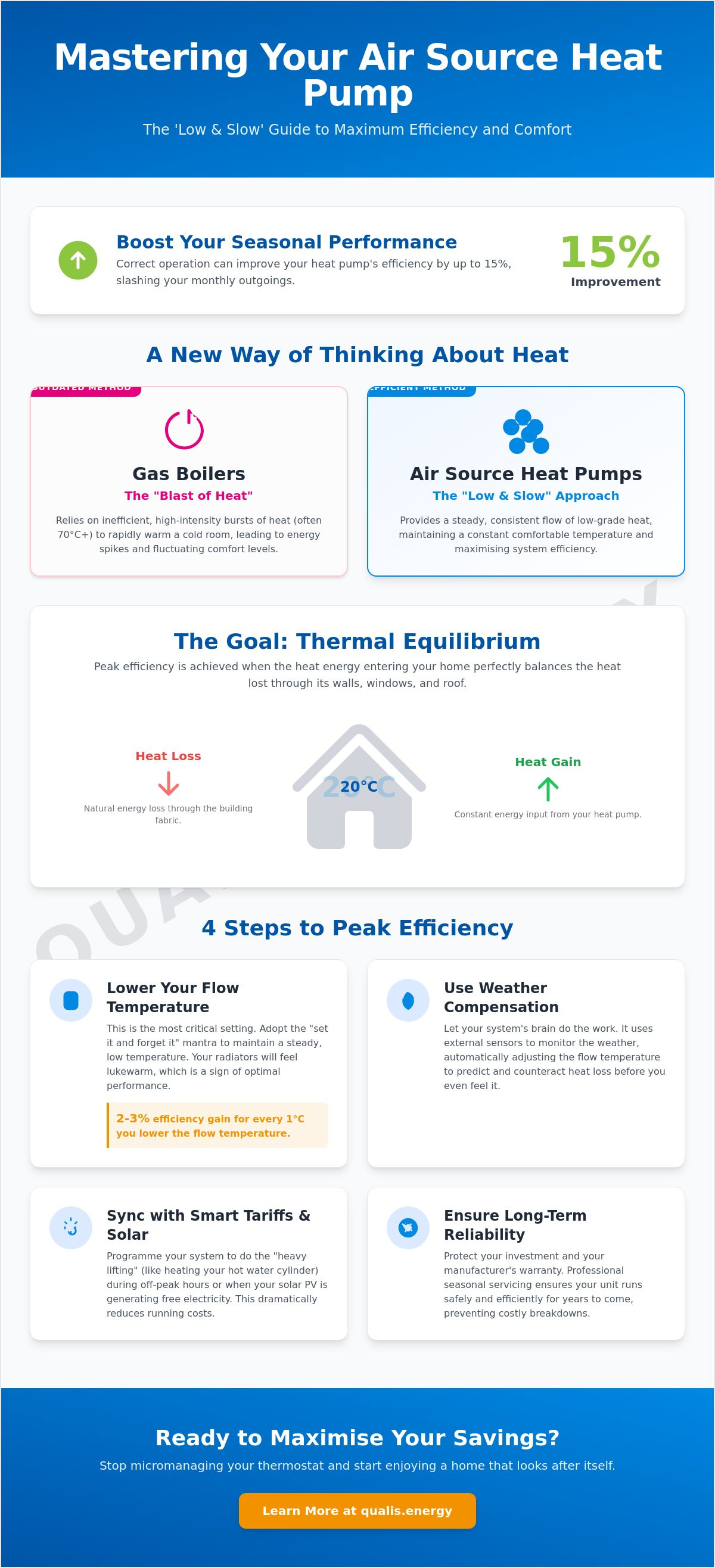
The era of gas is fading. We're holding high the renewable energy flag to guide homeowners through this vital national transition. Conventional boilers rely on high-intensity "blasts" of heat, often reaching 70°C, to rapidly warm a room from cold. Air source heat pumps operate on an entirely different logic. They provide a steady, consistent flow of low-grade heat that maintains a constant environment. This "low and slow" approach is the
most efficient way to run air source heat pump
systems in homes across Nottingham and Sheffield. In the East Midlands, where winter temperatures often hover between 2°C and 7°C, understanding
is vital for cost management. These systems extract ambient heat from the outside air and upgrade it for domestic use. You might notice your radiators feel lukewarm rather than scorching to the touch. This isn't a fault; it's a sign of a system operating at its peak performance level, delivering exactly the amount of energy required to offset heat loss without wasting electricity.
Why Constant Temperature Beats On-Off Cycles
Forcing a heat pump to recover 5°C of lost temperature every evening is an expensive mistake. It consumes significantly more electricity than maintaining a steady state because the pump must work at a higher frequency to bridge the gap. Your home's walls and floors possess thermal mass, which effectively acts as a domestic battery for storing energy. By keeping your thermostat at a consistent 19-21°C, you ensure the structure of your house remains warm throughout the day.
Thermal equilibrium is achieved when the heat energy entering the building matches the heat energy lost through the fabric of the walls.
This balance ensures you won't need to lift a finger to stay comfortable whilst keeping your seasonal energy bills as low as possible.
The Role of COP in Your Monthly Energy Bill
Efficiency in the heat pump world is measured by the Coefficient of Performance (COP). A COP of 4.0 indicates that for every 1kW of electricity used, the pump delivers 4kW of heat into your home. During a harsh Sheffield winter, high humidity or temperatures dropping below freezing can cause frost build-up on the external unit, temporarily lowering this ratio. This is why we focus on Seasonal COP (SCOP), which provides a more accurate average of performance across the entire UK heating season. Maintaining a low flow temperature is the
most efficient way to run air source heat pump
Optimising Your Heat Pump Settings: Flow Temperatures and Weather Compensation
The transition to renewable energy is a journey from old habits to new precision. Flow temperature, the heat level of the water leaving your pump to enter your radiators or underfloor pipes, is the most critical variable in this equation. Lowering your flow temperature by just 1 degree can increase your system's efficiency by 2 to 3 percent. This small adjustment translates into significant savings over a typical Sheffield winter, ensuring your investment pays dividends through lower operational costs.
UK homeowners are often used to the "blast and off" behaviour of traditional gas boilers. With a heat pump, we advocate for the "set it and forget it" mantra. This approach maintains a steady thermal mass in your home, avoiding the energy spikes associated with rapid reheating. It's the most efficient way to run air source heat pump systems in 2026. Recent advancements in heat pump technology mean modern units are engineered to thrive on these long, low-temperature run cycles rather than frequent starts and stops.
Mastering the Heating Curve for the UK Climate
Weather compensation is the brain of your installation. By using external sensors to monitor local conditions in Newark or Mansfield, the system predicts heat loss before it happens. If the mercury drops outside, the pump automatically increases the flow temperature to compensate. If your home feels slightly cool during mild spells, you can fine-tune the "curve" by adjusting the base setting by 1 or 2 degrees rather than cranking up the thermostat. Avoid using "boost" or "emergency heat" modes at all costs. These settings often engage direct electric immersion heaters, which ignore the heat pump's efficiency and drive up your electricity bills instantly.
Setting Your Domestic Hot Water (DHW) Schedules
Managing your hot water is a balancing act between comfort and cost. Storing water at 60°C requires significantly more work from the compressor than a target of 45-50°C. For most families, 48°C is the "sweet spot" for daily use. To ensure safety, you should organise a weekly Legionella protection cycle that raises the temperature briefly to kill bacteria. We recommend scheduling your main water heating for the middle of the day. Ambient air temperatures in the East Midlands are frequently 5 to 8 degrees higher at noon than at dawn, allowing the pump to work much less to achieve the same result. If you need help tailoring these settings to your specific property, you can speak with our design team to find your home’s ideal configuration.
Maximising Thermal Retention Across Your Home in the East Midlands
The future of domestic heating depends on a sealed envelope. Your air source heat pump installation is a high-performance engine that requires a well-insulated chassis to perform. In 2026, we see many homeowners in Sheffield and Nottingham investing in technology while ignoring the gaps under their doors. Efficiency is a partnership between the machine and the masonry. By securing your home's thermal envelope, you are holding high the renewable energy flag for your community, showing that 21st-century comfort is achievable in any property.
The most efficient way to run air source heat pump systems starts with steady-state operation. Unlike old gas boilers that blast heat at high temperatures, ASHPs prefer a "low and slow" approach. Aggressive zoning, where you shut off several radiators in unused rooms, often backfires. This forces the pump to cycle on and off frequently, a process known as short-cycling. This increases mechanical wear and reduces the Seasonal Coefficient of Performance (SCOP). Keeping your home at a consistent temperature across all rooms is almost always more cost-effective than micro-managing individual zones.
For those interested in how different equipment choices impact these long-term efficiencies, you can learn more about Vesinimas.LT and their range of heat pump solutions designed for consistent performance.
The Radiator vs. Underfloor Heating Debate
Underfloor heating is the natural partner for ASHPs because it operates at low flow temperatures of roughly 35°C. This allows the pump to work at its peak efficiency. If you're keeping existing radiators in a Chesterfield semi-detached, they must be sized correctly. Modern "low-temp" radiators have a larger surface area, often 2.5 times larger than standard models, to emit sufficient heat at lower water temperatures. We recommend a "don't turn off" rule for thermostats. Set them to a steady 18°C in spare rooms to maintain the thermal mass of the building rather than letting the space go cold.
Insulation: The Foundation of Renewable Success
Older properties in Rotherham can lose 25% of their heat through an uninsulated roof. We ensure your home is ready before the first pipe is laid. High-performance loft insulation and cavity wall treatments allow for a smaller, more affordable 5kW or 7kW unit rather than an oversized 12kW model. This reduces your initial investment and monthly bills. Practical draught-proofing is a small win that protects your investment. Simple steps include:
Sealing letterboxes and keyholes: Prevents cold air ingress in exposed Sheffield hillsides.
Thermal curtains: Adds a layer of resistance to 20th-century glazing.
Pipe lagging: Ensures heat generated by the pump actually reaches your rooms.
We manage this entire transition from initial survey to final handover. You won't need to lift a finger as we transform your property into a beacon of efficiency. A well-insulated home means your heat pump works less, lasts longer, and costs less to run every single month.
Reducing Running Costs with Smart Tariffs and Solar PV Integration
The UK's energy grid is evolving rapidly. By 2026, the traditional flat-rate tariff has become a relic of the past. To find the most efficient way to run air source heat pump units in homes across Nottingham and Sheffield, we must look at the synergy between hardware and software. Smart tariffs, such as specific 2026 heat pump trackers, offer electricity at significantly reduced rates during periods of low national demand. By synchronising your heat pump's "heavy lifting" with these off-peak windows, you transform your heating system from a standard utility into a strategic financial asset.
Leveraging Solar Energy for Heating
Your roof is a power station. In the shoulder months of spring and autumn, solar PV can make your heating virtually free. The most efficient way to run air source heat pump technology during these periods is to use excess generation to "pre-heat" your hot water cylinder to 60°C during the day. This thermal storage acts like a battery, keeping water hot for evening use without drawing a single watt from the grid. By harvesting photons to drive the compression cycle directly, solar-ASHP integration creates a "closed-loop" energy system that shields homeowners from the volatility of global fossil fuel markets.
Smart controllers now talk directly to both your panels and your pump to prioritise self-consumption.
Diverters can automatically send spare solar energy to the immersion heater as a secondary boost.
Modern battery stacks allow you to store daytime solar for the pump's early morning warm-up cycle.
Smart Tariffs and Automated Load Shifting
Avoiding the 4pm to 7pm peak is the golden rule of modern energy management. This three-hour window is when the grid is most carbon-intensive and expensive. Automated systems now allow your heat pump to work harder when the grid is "green" and cheap, then coast through the expensive evening peak using the heat already stored in your floors or radiators. It's a sophisticated dance of data and thermodynamics that happens entirely in the background.
Qualis Energy ensures this transition is seamless. We manage the entire turnkey process, from the initial G98 or G99 DNO applications to the final commissioning of your integrated battery stack. Our team handles the technical bureaucracy so you don't need to lift a finger. We are holding high the renewable energy flag in the East Midlands, ensuring every installation is a masterpiece of efficiency and compliance. Partner with Qualis Energy to future-proof your home's heating today.
Professional Servicing and Seasonal Maintenance for Long-Term Reliability
The future of home heating relies on precision. Your heat pump is a sophisticated piece of engineering that requires consistent care to maintain its peak performance. An annual professional service is mandatory to preserve your manufacturer warranty. Without a recorded service history, major brands often void their 7-year or 10-year guarantees. This yearly check ensures your system remains the most efficient way to run air source heat pump technology while protecting your long-term investment. We handle the technical complexities so you can focus on the comfort of your home.
Homeowner Maintenance Checklist
Maintaining your system does not require technical mastery. You can keep everything running smoothly with a few simple, proactive checks. We recommend a monthly habit of monitoring your system to ensure everything is functioning as designed.
Check the internal controller for any unusual error codes before they develop into a system lockout.
Ensure the area around your external unit is clear of bins, garden furniture, or overgrown foliage for at least 500mm.
Monitor the system pressure gauge. It should typically sit between 1.0 and 1.5 bar.
Bleed radiators if you notice cold spots at the top, as trapped air reduces heat transfer efficiency.
The Qualis Energy Servicing Advantage
Our engineers provide a comprehensive health check that goes far beyond a surface-level inspection. We manage the entire process, from checking the chemical integrity of your glycol levels to calibrating pump flow rates for maximum heat transfer. We ensure your system is perfectly balanced to provide domestic comfort without wasting a single kilowatt of energy. Our team takes pride in holding high the renewable energy flag, ensuring your transition to green heat is permanent and hassle-free. You will not need to lift a finger once our team arrives to optimise your setup. Ensure your system stays at peak efficiency and book your annual ASHP service with Qualis Energy today.
Future-Proof Your Home’s Comfort and Efficiency
Transitioning to low-carbon heating is more than a simple technical upgrade; it's a commitment to a sustainable future for your family and the wider East Midlands community. By mastering weather compensation settings and prioritising thermal retention, you ensure your system operates at peak performance throughout the British winter. Adopting a "low and slow" heating philosophy remains the most efficient way to run air source heat pump technology, especially when paired with smart tariffs that capitalise on off-peak electricity rates. Data from the Microgeneration Certification Scheme (MCS) highlights that correctly configured systems significantly outperform traditional gas boilers in seasonal efficiency.
At Qualis Energy, we hold high the renewable energy flag across Nottinghamshire and South Yorkshire. Our MCS Accredited installers specialise in Mitsubishi and other leading ASHP brands, providing a complete turnkey service from the initial design to long-term maintenance. We handle every detail, including G98 and G99 DNO applications, so you won't need to lift a finger. Whether you're in the heart of Sheffield or the rural outskirts of Nottingham, our local experts are ready to guide you through this national energy transition with confidence. It's time to transform your home into a beacon of modern efficiency.
Frequently Asked Questions
Is it cheaper to leave my heat pump on all day or use a timer?
It's generally more cost-effective to maintain a steady temperature rather than using a traditional on-off timer. Heat pumps work by moving heat rather than creating it, so they operate at peak performance when they don't have to work hard to recover a 5-degree drop in room temperature. We recommend a setback strategy where you lower the thermostat by 2 or 3 degrees at night. This approach represents the most efficient way to run air source heat pump systems in the fluctuating climate of Nottingham and Sheffield.
What is the best flow temperature for an air source heat pump in the UK?
The most efficient flow temperature is typically between 35°C and 45°C. Lowering your flow temperature allows the unit to achieve a higher Coefficient of Performance (COP), often reaching 3.5 or 4.0 units of heat for every unit of electricity consumed. According to the Heat Pump Association, every 1°C reduction in flow temperature can improve efficiency by approximately 2% to 3%. We design our systems to ensure your home stays warm even at these lower, more sustainable temperatures.
How much can I save by using weather compensation settings?
You can improve your system's efficiency by up to 15% by enabling weather compensation. This feature automatically adjusts the water temperature in your radiators based on the outside air temperature. When it's a mild 10°C in South Yorkshire, the pump runs at a lower flow rate; when a frost hits, it ramps up. This intelligence ensures you aren't wasting energy during milder spells, moving your home from basic heating to a smart, responsive environment.
Can I run my air source heat pump at 60 degrees efficiently?
Running a heat pump at 60°C is possible but significantly less efficient. Most standard units see their COP drop below 2.0 when pushing for such high temperatures, effectively doubling your running costs compared to a 40°C flow. If your home requires 60°C to feel warm, it usually indicates that your radiators are undersized or your insulation is insufficient. We focus on the whole-house transition to ensure you don't need to rely on such high, energy-intensive settings.
What happens if my heat pump unit ices up during a cold Sheffield night?
Don't worry if you see ice; your heat pump is designed to handle it. The unit will automatically enter a defrost cycle where it temporarily reverses its operation to melt the frost from the external coils. This process usually lasts between 5 and 10 minutes and is a standard part of winter operation. Our team ensures your unit is installed with proper drainage so that the melted ice clears away safely without creating a slip hazard.
How often should I have my air source heat pump serviced to maintain efficiency?
You must schedule a professional service once every 12 months to maintain peak efficiency and protect your warranty. Regular maintenance ensures the evaporator coil is clean and the refrigerant levels are correct, preventing the 5% to 10% efficiency loss that can occur in neglected systems. From the initial installation to annual check-ups, we manage the entire lifecycle of your system so you won't need to lift a finger to keep your home warm.
Do I need to change my radiators to make my heat pump more efficient?
In many UK homes, replacing or upgrading radiators is the most efficient way to run air source heat pump technology. Because heat pumps run at lower temperatures than gas boilers, you need a larger surface area to distribute the same amount of heat. Upgrading to Type 22 or Type 33 radiators can increase heat output by 30% or more without requiring higher flow temperatures. We provide a full room-by-room heat loss calculation to determine exactly which radiators need an upgrade.


Comments